Showing posts with label dinner. Show all posts

Wednesday, October 14, 2009

Fried Macaroni

macaroni fried 3

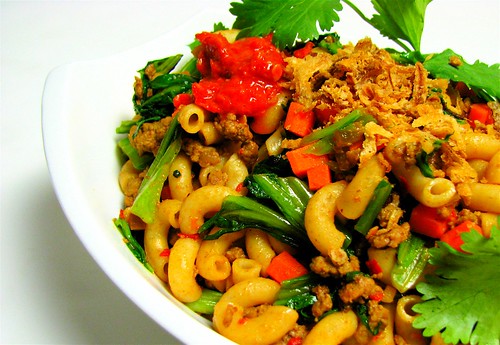
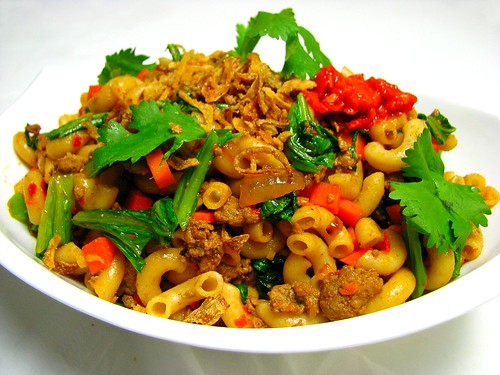
When I was prepping to cook this fried macaroni, I could almost hear my mum's exclamation in the background. Not so much because this was an exciting dish (it isn't), but because it is a dish my mum would whip-up whenever we were having guests on short notice. She would exclaim in dismay that there was no time to cook a proper family-style meal. Then she would survey her pantry — if she was short of any ingredient, she would send my father, or me (when I was older) to the grocery store. Her hands moved fast, reaching out for the pot to fill it with water for the macaroni. She pulls out her knife to cut the carrot and greens, and mince the garlic and shallots. All the while muttering under her breath what dishes she have preferred to cook, that her guests would have enjoyed more.

Her guests did in fact enjoy her fried macaroni. As did we, so we urged her to prepare it for our regular meals instead of just having it as an "emergency meal". She was happy to oblige because it is such a simple, yet hearty dish. Kind of right for the beginning of fall.
fried macaroni

Fried Macaroni (Macaroni Goreng)

2 cups whole wheat macaroni
2 tablespoons oil
3 shallots or ½ small onion, minced
2 garlic, minced
1-inch ginger, minced
2 tablespoons water
1 cup diced carrot
2 cups chinese mustard green (also known as gai choy or sayur sawi)
½ cup cooked minced beef
1 tablespoon oyster sauce
1 tablespoon tomato ketchup
1 tablespoon sambal oelek
½ cup fried shallots
a few sprigs of cilantro

1. Cook macaroni as directed by package.

2. Heat-up oil to medium heat in a wok or pot. Saute the onions for about 3 minutes until carameralized. Add garlic and ginger and fry for another 2 minutes. Add the carrots, chinese mustard green and water. Stir and cover to steam the vegetables for about 2-3 minutes.

3. Remove the cover. Put in the minced meat and macaroni. Pour in the oyster sauce, tomato ketchup and sambal oelek. Stir all the ingredients together and cook for about 2 minutes.

4. To serve, garnish with fried shallots and cilantro.

Monday, October 12, 2009

Dinner Tonight

shrimp salsa bisque

Monday, October 5, 2009

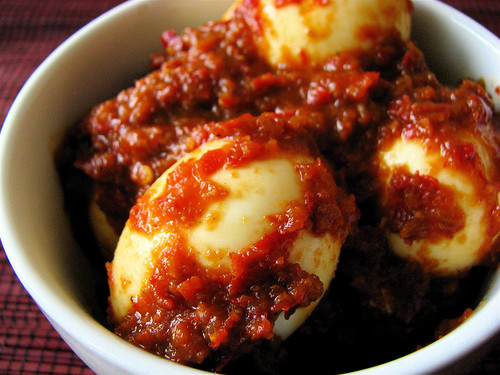
Egg Sambal Tumis and Fried Sardines

egg sambal tumis 1

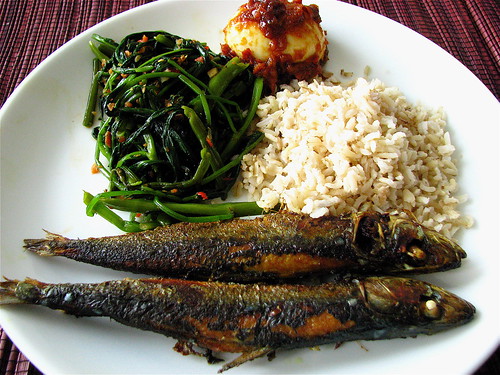
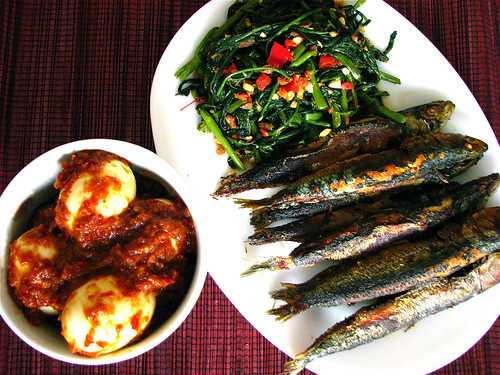
For me, one the surprises about living in the Bay Area is the number of Singaporeans who are here. We are lucky to have made a few good friends from Singapore who, of course, share our love of good food. I cook often and enjoy inviting our friends for a meal. Usually, having guests over for a meal require some planning. But when you can make simple home-cooked food for a fellow Singaporean, little planning is necessary. For this meal, I already had eggs in the fridge. Dried chilies are a pantry staple. Then I picked-up some kangkong from the Chinese supermarket and fresh sardines from Whole Foods to complete our menu.

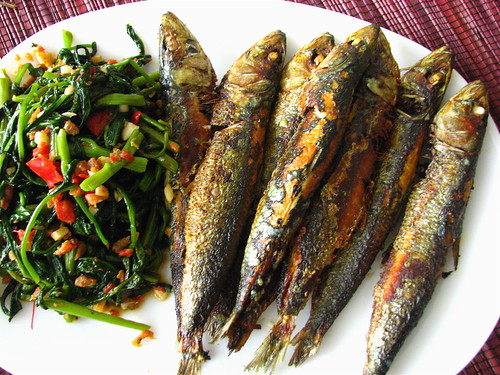
I made sambal belacan kangkong with the sambal belacan from my mum. The sardines were fried and the eggs were boiled for sambal tumis. This is a sambal where dried chili paste is sauteed until it turns into a deep red and then sweetened with sugar. And I love pairing this sambal with fried fish because they go so well together. My mum would serve these dishes with nasi lemak, which is white rice cooked in coconut cream with a pandan leaf or two thrown in. But for that night, we had brown rice with our simple kampung ('village') dishes.

egg sambal tumis 3

egg sambal tumis 2


Egg Sambal Tumis
(Sambal Tumis Telur)

6 eggs
1 oz or 20 dried chilies
10 shallots
3 garlic
1-inch shrimp paste (belacan), toasted
2-inch tamarind paste
1½ cup hot water
2 tablespoons sugar

1. Make hard boiled eggs. Cool and peel the shells.

2. De-seed the dried chilies and soak in warm water for half an hour. Pound or grind to a paste. Peel the shallots and garlic, then pound or grind with shrimp paste. Put the tamarind paste into the hot water to make tamarind juice.

3. Heat oil in wok or saucepan to medium heat. Add in the shallot, garlic and shrimp paste blend. Saute for about 2 minutes. Add the chili paste and continue frying for 2 minutes. Then add the tamarind juice. Bring to a boil, then lower heat and continue cooking until the mixture turns into a deep red, about 15-20 minutes. Add sugar and stir until it dissolves. Taste the sambal. If there is too much heat, add more tamarind juice and/or sugar.

4. Switch off the heat and add the eggs.

Fried Sardines (Ikan Tamban Goreng)

6 fresh sardines
1 teaspoon turmeric powder
1 teaspoon salt
oil for frying

1. Gut and clean the fish (you can ask your fishmonger to do it). Dry the fish as much as possible. Then rub the sardines with turmeric powder and salt.

2. Heat about ½-inch oil in a wok or pan to high heat. Put in the sardines; in batches if necessary. Lower the heat slight. Fry until the fish turn golden brown, or about 3-4 minutes. Then turn over and fry for another 3 minutes.

3. Remove fish onto paper towel to drain the oil.

egg sambal tumis 6

Thursday, October 1, 2009

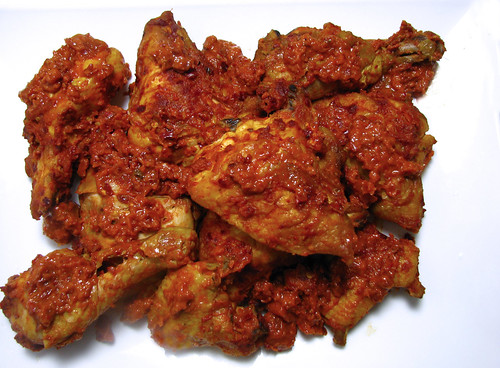
Ayam Masak Merak — A Classic Malay Chicken Recipe

ayam masak merah recipe chicken in red sauce

When I left Singapore, I left behind a gaggle of girlfriends. Oh, how I miss them. Long conversations, gossip over food, steady shoulders for a good cry. You know those sort of friends.

Moving here, I had no expectations when it came to making new friends. I was lucky because I already had one good friend, B, who lives 10 minutes away. And I grew close to one of S's friends, L. That was enough for my social life. I was busy with moving homes, settling down and studying. After my exams, we went to a Singapore network event (because we thought they would have good Singapore food) and during the reception, while we were munching on some spring rolls, another couple joined us at our table. We introduced ourselves. She's from Singapore too and just moved with her French husband. We did small talk and being Singaporeans, of course, we chatted about food.

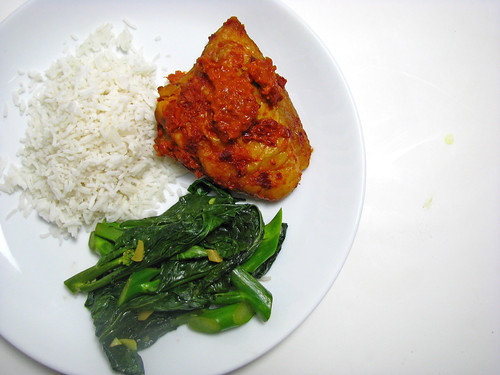
Fast forward 18 months later, and we — D and I — are still chatting about food. In fact, we've gone beyond that - we've both set up blogs where we talk a lot about food. So to celebrate her birthday, of course, food was involved. Last night, I made dinner for her and her adoring husband, M. I decided to make one of my mum's Malay chicken dish, ayam masak merah (recipe below). Literally it means "chicken cooked red", which sounds a little strange translated. But the sauce is a blend of red dried chilies and pureed tomatoes. The only thing different I did from my mum was to roast the chickens instead of frying them. It was a nice taste of home, in the company of semi-new friends — eating, talking, laughing. So it was a celebration not just of a birthday, but of friendship, as well.
ayam masak merah 13
After dinner, we had dessert. I always make desserts when we have friends over. But last night, I didn't because D brought some. Why would I let the birthday girl bring her own dessert? Because she's been busy making them everyday for the last month! Yup, everyday. So let's celebrate her birthday today by looking through every single of her yummy desserts on her blog — bonvivant. Watch the drool!

Chicken in Red Sauce ("Ayam Masak Merah")

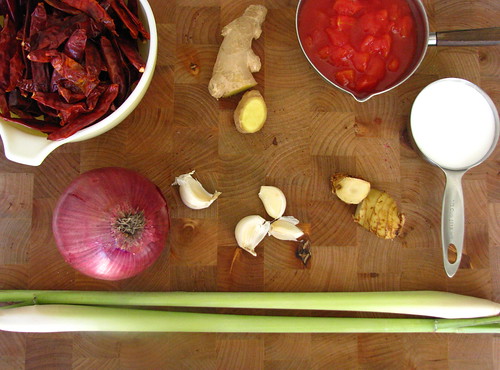
3 oz dried red chilies or ½ cup of dried chili paste
1 whole chicken
1 teaspoon tumeric
2 tablespoons oil
1 medium sized onion
4 cloves of garlic
2 inch ginger
1 inch galangal
2 lemongrass
1 cup tomato puree or diced tomato
½ cup coconut cream
1 tablespoon sugar
salt

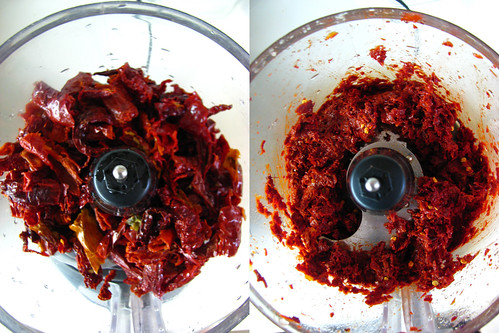
1. De-seed and cut the each dried chili into 2-3 pieces. Soak in warm water for 30 minutes.

2. Heat oven to 400°F. Cut the chicken into 8-10 pieces. Marinate with oil, salt and turmeric. Roast for 30 minutes or until the internal temperature reaches 165°F.

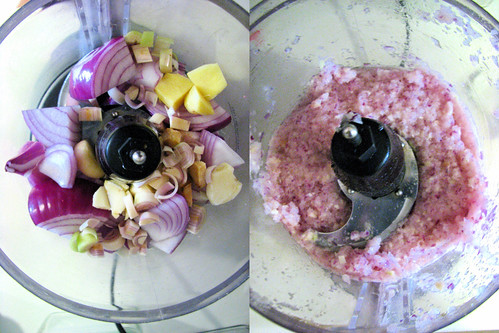
3. Peel onion, garlic, ginger and galangal, cut into smaller pieces and place into food processor. Take one of the lemongrass stalks and cut the just the white part into smaller pieces, also to be placed in the food processor. Grind until you get a smooth paste (you may need to add a couple tablespoons of water to get it started). Remove spice paste from food processor. If using diced tomato, put in food processor and puree. Remove puree into a bowl. Then place the dried chilies in the food processor and grind.

4. Heat 2 tablespoon oil in a wok. Saute the spice paste for about 3 minutes. Take the bottom 8-inches of the remaining lemongrass and bruise with the back of your knife. Add the lemongrass, chili paste, tomato puree and coconut cream. Stir until all the ingredients are well-incorporated. Bring to a boil, then let it simmer for 20 minutes. In the last minute, add salt and sugar. Taste - add more salt if necessary and diced tomatoes if it is too spice.

5. Put in the roasted chicken pieces and mix until the chicken pieces are well coated with the sauce.

Serve with rice and a side dish of vegetables.

ayam masak merah recipe chicken in red sauce

ayam masak merah recipe chicken in red sauce

ayam masak merah recipe chicken in red sauce

ayam masak merah 18

Wednesday, September 23, 2009

Sambal Oelek Roasted Chicken

roasted chicken sambal oelek recipe

This is a quick post. S and I are about to go out to spend an afternoon in the city. We are going to hear Karen Armstrong speak as part of the City Arts & Lecture series this evening and before that we'll catch the Avedon exhibition in SFMoma.

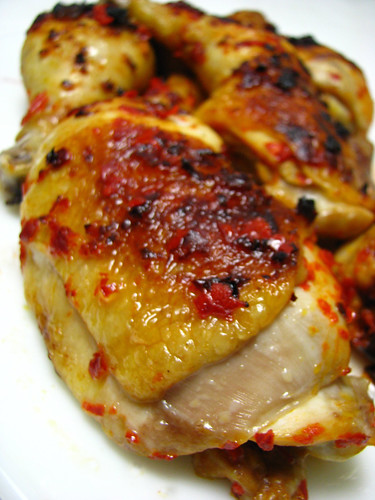
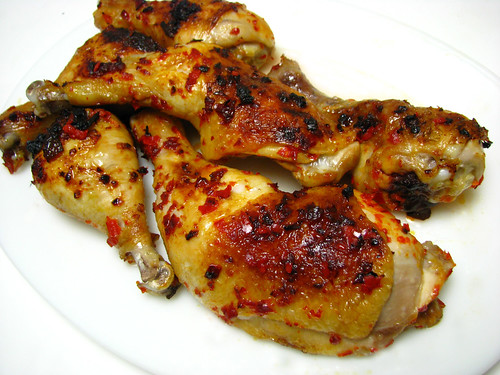
Last night we made sambal oelek roasted chicken. This is my too lazy too cook dish. Remember the sambal oelek? I simply mix it with oil and rub it all over the chicken pieces and under the skin and toss them in the oven. Use 3 tablespoons of sambal oelek and two tablespoons of chili oil or vegetable oil for about four large pieces of chicken legs and roast at 400°F for about 30 minutes. Smaller pieces may be done earlier so watch the oven. While waiting, I boiled some small potatoes for my cilantro yogurt dressing. Quick braise shredded cabbage and carrot, and we have a meal.

roasted chicken sambal oelek recipe

roasted chicken sambal oelek recipe

Sunday, August 30, 2009

Reviewing Madhur Jaffrey's memoir

duck curry - madhur jaffrey's

I have an addiction - a literary addiction to memoirs of writers. You recall that a couple of months ago, I read one by Haruki Murakami. I have read many others previously but my all-time favorite is John McGahern's All Will Be Well. I just finished another by Madhur Jaffrey - Climbing the mango trees; a memoir of a childhood in India - and this one is a very close runner-up to McGahern's.

Madhur Jaffrey is a popular cookbook author of Indian cuisine. What drove me to pick up her cookbooks is my abysmal failure to produce any decent Indian curry despite my best efforts. It's either the yogurt curdling in the gravy or the spices tasting bitter. But when I started trying recipes from her book, I was suddenly cooking edible curries - much to the relief of my husband. I was impressed and reserved a copy of her memoir from the local library.

It is clear that she had a privileged childhood not just by Indian standards, but by any standard. However, there is no hint of smugness or pride. She tells her stories from the perspective of the child that she was and it does not sound contrived. I was amused because I found myself internally comparing our childhoods which could not be more different. She comes from a respectable, almost aristocratic background whose family history is contained in a thick, red leather bound book entitled "Short account of the Life and Works of Rai Jeevan Lal Bahadur, Late Honorary Magistrate, Delhi, with Extracts from his Diary Relating to the Time of the Mutiny, 1857" although it included details of family history prior to that. Could it be more grand? Much of my family history is truncated partly because of the number of adoptions in the family (this was a time when there was no record for adoptions). Part of her childhood was spent in a family homestead with two annexes which housed up to nine families comfortably. Part of my childhood was in a rented L-shaped flat - it had no rooms, was much like a studio but had to fit our family of five. Her family had a garden of not only flowers but all the vegetables for their meals (potatoes, onions, carrots, okra, eggplant, cauliflower, cabbage, kohlrabi, tomatoes...). I don't think I ever saw a vegetable garden except on television, until I was an adult.

It's not that I like to compare my life to the lives of the writers, but the way she writes draws me back to a time when I was young too. I tried to recall if, as a child, I had the same perspective. I identified with her when she chatters about her days in school. It was so easy to slip into the stories that she tells. I felt like I was a child as young as she was then, and she was taking my hand and leading me through her life - pointing out, in rich details, the saris that her mother favors and the eccentricities of her uncle, and nudging me to taste the lush, spiced foods, or suck the tart juice straight from the skin of mangoes from Benares.

duck curry - madhur jaffrey's

duck curry - madhur jaffrey's

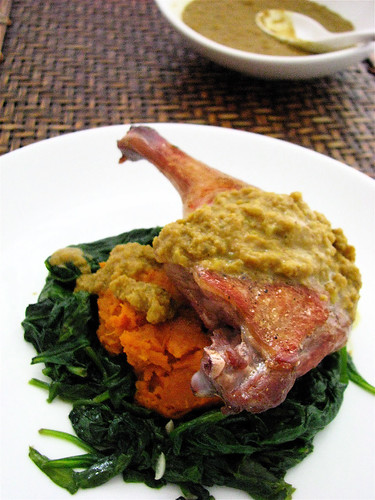
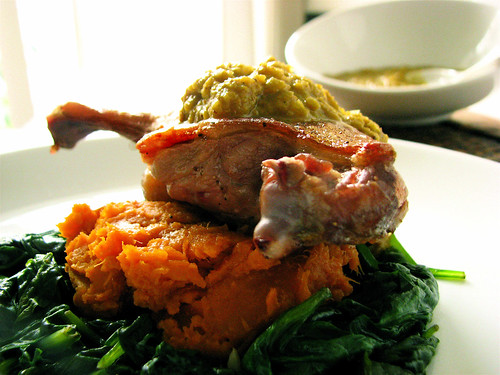
Above are pictures I barely managed to take of a dinner I made with a family recipe she shared - Classic Duck Curry with Coriander and Cardamom. As you can see, I deconstructed it a little bit. I fried and roasted the duck to make it crispy, and cooked the curry separately. I had some sweet potato left from a previous dinner and decided to make a mash before plating it with some sautéed spinach. I rested a crispy duck leg on the mashed potato and poured some of the curry over it. I don’t usually plate my food this way – this was totally spontaneous and we had a good laugh over it. The curry was flavorful especially since I added a little of the duck fat to it (as would be the case if the duck was cooked in it). I was surprised at how well sweet potato goes with curry.

Of course I looked-up more information on her and I like these:
A conversation between Madhur Jaffrey and Maya Angelou.
She aspired to be an actress before she started writing about food.
BBC has a series of videos of her instructive cooking - so useful for me.

I feel a little sad that I have to return the book to the library tomorrow, but I will be looking to get a copy for my own library.

Tuesday, August 25, 2009

Coconut milk lemongrass broth with salmon

asian coconut milk broth salmon recipe

I think I have grown more sentimental since I moved 8,000 miles away from my family. Every memory I have of home seems to be sepia-tinted and filled with gentle smiles. There is no darkness, no anger, no crying. Yes, this must be a side effect of homesickness and I won't worry yet until I see small children running in slow motion. But it's nice being able to go to that happy place when life gets intimidating.

When I spoke to my mum on Friday, she was telling me how my niece, 2½ years old, typed on her toy laptop and began to fret, "So much work! This is giving me a headache-lah." I laughed not just because I can see her tiny self doing exactly that - she was clearly imitating her mum - but I used to do the same thing. When I was 7 and helping my mum with small chores, I would take a break to wipe the imaginary beads of sweat off my forehead with my forearm and breathed a heavy sigh.

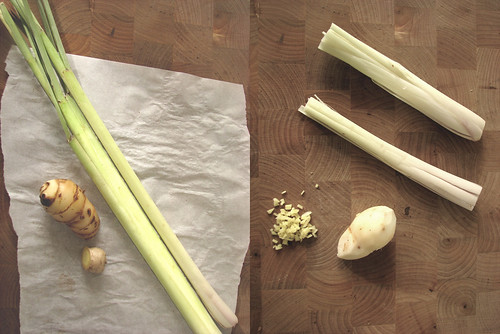
And it is the same in the kitchen. My mum never taught me to cook as in "For today's cooking lesson, we are going to make ....", but many things she did are imprinted in my mind even though I was not consciously trying to learn from her. Every now and then, I find myself doing things that imitates the way she preps and cooks. It happened again when I made this coconut milk lemongrass broth. I did not follow any particular recipe, and conventional preparation requires me to slice the galangal thin and chop the lemongrass into 1-inch pieces. But I did as my mum would - I just peeled the galangal and cut it into 2. I cut-off the lower half of the lemongrass and just bruised it. And both go into the pot as-is, so that when I scoop the broth, I can easily remove the lemongrass and galangal. While they add flavor, they are not all that pleasant to bite into.

I think she would like this broth. It has flavors that she is familiar with. When I have leftover ingredients, fried rice is usually a sure bet. Mixed vegetables - carrots, long beans, any greens - and perhaps a handful of meat, all so easy to throw into the wok. But sometimes, I have the odd herb or two that didn't quite make it into the food processor for the rempah (spice paste) for a Malay dish like sambal goreng or mee rebus. Lemongrass, galangal, kafir leaves - when stored in the fridge, they are good for a few days. But if I don't feel like making more rempah, this coconut lemongrass broth is my go-to meal. It is so easy to make and I still make it even when I don't have the exact quantity of ingredients, for example, if I just have 1 lemongrass or an inch of galangal. I just let the broth simmer a little longer. If you have never used lemongrass or galangal, I think this broth is a perfect introduction for a first-time attempt.

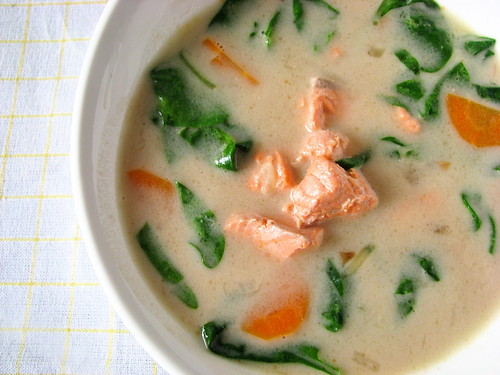
This broth is a take on the Thai dish tom kha gai, which means "boiled galangal chicken" and usually provides gravy for rice. I make it less thick so that I can drink it directly - perfect if you just want something light. S stirred some brown rice into his. Instead of chicken, I used salmon. I also added carrots and spinach because I had those at hand. There is no heat but feel free to sprinkle a little red chili peppers like my husband did.

asian coconut milk broth salmon recipe

asian coconut milk broth salmon recipe

Coconut milk lemongrass broth with salmon

1 fillet salmon, about 5 oz
2 handfuls baby spinach leaves
½ cup sliced carrot
2 shallots, minced
2 garlic, minced
1 inch ginger, mined
2 lemongrass stalks
2-3 inches galangal, peeled
1 tablespoon fish sauce
1 cup coconut milk
2½ cups vegetable stock
1 tablespoon oil

1. Heat the oil in a saucepan at medium heat. Saute the minced shallots until caramelized and then add garlic and ginger. Stir for about 1 minute. Take the bottom part of the lemongrass and bruise it - I use a pestle. If the galangal is larger, cut it into 2. Put in the lemongrass, the galangal and fish sauce. Stir until fragrant, about 1 minute. Put in the vegetable stock. Bring to a boil and then let it simmer at a lower heat for about 20 minutes.

2. Pour in the coconut milk and continue to simmer for about 5 minutes. Cut the salmon fillet into 1-inch cubes. Put the salmon cubes in the broth to let it poach. When the salmon becomes opaque, throw in the spinach. Stir gently and switch off the heat. Serve immediately.

Serves 2

Tuesday, July 14, 2009

The Sambal Series - Sambal goreng sayur

sambalgorengsayur14

I can't say if marriage is what I expected it to be. I think for both of us, it took time getting used to living with someone. I'm sure part of it was because we got married at an older age - we were pretty much set in our ways by then. One minute I am this independent woman running my own business. The next minute I am sitting cross-legged in his living room in another continent, wondering where I can fit all my books. We have had plenty of adjustments to make along the way.

One of the things that fall on both ends of the get-along-meter is food. It is something that unites us and at the same time, causes some arguments. We grew up eating Malay food, so we love the savory taste of Malay rempah (spices) that flavors our food. We enjoy spending time in the kitchen trying to recreate the smell and taste that peppered our childhood and arguing whose mum made a better ____ (any Malay food). But he is also a red meat lover. Those last three words should be capitalized just to emphasis how much he loves red meat, but I am too polite to be shouting over the web. I really have no objection to my husband eating red meat but for health reasons I would like him to eat less of it. We "discuss" this a lot.

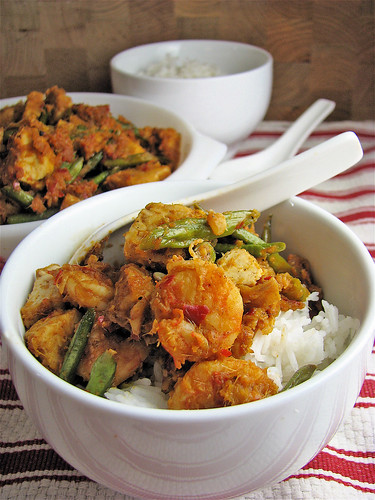
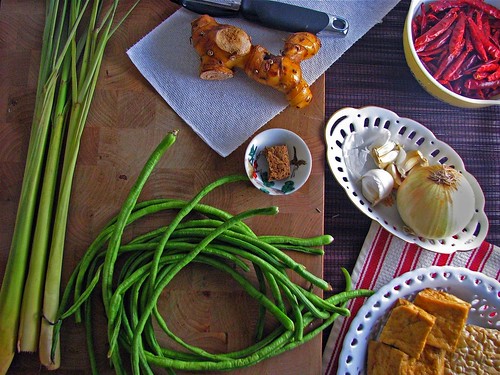
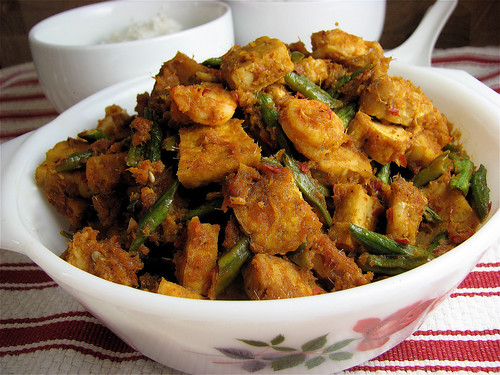
So I look for meat-less recipes which I think will satisfy his tastebuds. My mum's sambal goreng sayur recipe is one such recipe. The rough translation for the dish is "fried chili vegetables". She usually makes it with beef but I decided to make it with prawns. I was glad to hear that he liked it just as much. This recipe is a typical of Malay food. Onion, garlic, belacan, lemongrass, galangal and chilli blended into a spice paste and then fried until fragrant. My mum suggested one cup of dried chilli but it was too much heat, so I reduced it to half a cup.

sambalgorengsayur13

sambalgorengsayur12


Sambal Goreng Sayur

½ cup dried chili, de-seeded and blended into paste
1 onion, medium sized
5 garlic cloves
3 lemon grass stalks
1-inch square belacan (shrimp paste)
3-inch galangal
1 tablespoon tamarind paste to produce ½ cup of tamarind juice
2 tablespoons sugar
15 long beans, cut into 2-inch pieces at an angle
1 8-oz tempe
1 8-oz baked or fried tofu
(tofu & tempe cut into 1 by 2-inch blocks & lightly fried separately)
1 lb prawns, shelled and de-veined, lightly fried
oil for frying

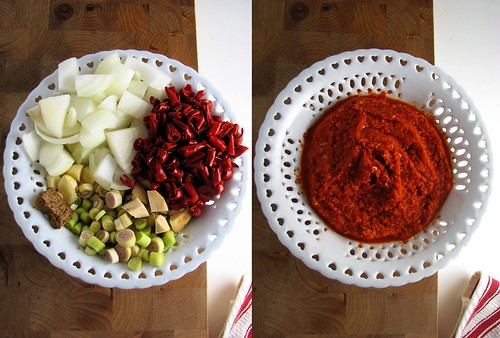
Rempah (spice paste) - Peel and chop galangal, lemongrass, onion and garlic into 1-inch pieces. You don't have to exact because all will be blended. Use only the white and light green part of the lemongrass. Put the chilli paste, lemongrass, onion, garlic, belacan and galangal into a blender or food processor - grind until mixture becomes paste. Heat 1 table spoon of oil in a wok. Put in the rempah, sugar and tamarind juice - be careful of oil splatter - and fry until fragrant. Stir often so that the rempah doesn't burn. This may take 15-20 minutes.

Remove the rempah and clean the wok. Heat about 2 tablespoon of oil (medium heat). Fry the long beans for about 2 minutes. Then put in the tofu, tempe and prawns. Stir-fry for one minute. Add the rempah and mix well. Fry for about 5 minutes, stirring occasionally. Serve with rice.

Serves 4

sambalgorengsayur15

Thursday, July 9, 2009

Baby bok choy no recipe

steamed blanched oyster sauce bok choy recipe

I've just been befriended on Facebook by several of my former dorm mates whom I have not seen since I left college. That brought back some memories. Now, I don't remember much from that time - just that there was a lot of sharing. Carrying a small basket of your toiletries into the shared bathroom. Rushing out of your second-floor room because you think you heard someone yell your name for a phonecall and running down to the shared phone on the ground floor. And of course there were the meals.

There was one small kitchenette in the whole block and sometimes, we got together to make our meals. I say "make", as opposed to "cook", because little to no cooking was involved. It is embarrassing to reveal, but one of our standard meals consisted instant noodles for carbohydrate, hot dogs for protein and blanched lettuce leaves for, err, nutrients. We simply boiled some water, blanched a few lettuce leaves, set it on a plate and drizzle a little oyster sauce over it.

steamed blanched oyster sauce bok choy recipe

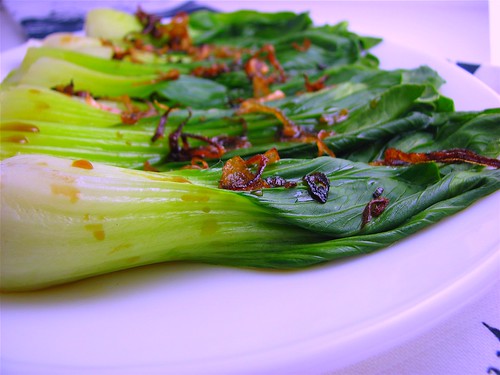
So for dinner last night, I made a baby bok choy dish that was inspired by those dorm-life memories. It's one of those dishes that doesn't really require any recipe. This time I steamed them instead of blanching them. You'll need two or three bunches of baby bok choy. Cut of the base of the stems - you can leave some of the smaller leaves together intact. Clean them well as they can be sandy. Just immerse them in cold water and rinse a couple of times. Boil some water in a pot - I use a silicone steamer because it's easy to clean. Steam the baby bok choy for about 2 minutes or more if you want them wilted. I like mine with a little bit of crunch in them. Then lay them out on a plate. Mix a teaspoon of oyster sauce with 2 teaspoons of water and drizzle it over the bok choy. Add a few drops of sesame oil and garnish with crispy fried shallots (or onions)*. Serves 3 or 4. It's a simple dish that complements a meal with rich or spicy dishes.

*I usually make a batch of fried shallots and store, but you can buy them in any Indian or Middle Eastern grocery store. They add flavor and texture to many Singapore dishes.

Tuesday, June 30, 2009

The Sambal Series - Sambal stingray

stingraysambal

I had a timid youth when it came to late night partying. The idea of going to a club always turned out to be more fun than the actual experience. The part of the evening I enjoyed best was the supper we would go to afterwards. Blurry-eyed and half-deaf from having 100 decibels drummed into our ears, it may take prata and teh tarik or Teochew porridge to recalibrate our senses. But eventually, we just dropped the disco beat and went straight to the late-night supper.

Oh, the options we had in Singapore for nocturnal makan.... At the top of my list are the sambal stingray and sambal kangkong from the seafood stall at Adam Road hawker center. As we discussed important issues of day - politics, gossip or matters of the heart, our fingers nimbly work the chopsticks into the white flesh of the fish. I made sure every picking include enough sambal so that I could taste the mingling of salty-sweet spice and fish with each mouthful. I remember the food better than the conversations. Perhaps we might accompany our meal with calamari or clams, but the stingray and the kangkong were a must. We ate with relish until we had to scrape the fish meat from its bones.

Sadly, since I moved to the Bay Area, I have been hard-pressed to find stingray in any of the supermarkets. But last week, while I was shopping for pomfrets at Ranch 99, I spotted these bottom feeders at the fresh seafood section. Or rather, I spotted the "wings" of the stingray. I was so excited, I wondered who I could call to share the news. Yes, that is my life now. So I bought one, went home and plotted my sambal.

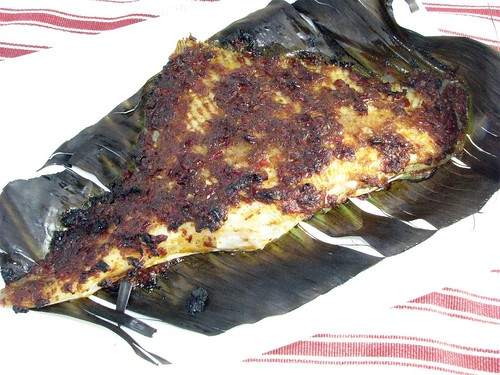
My husband helped me peel off its rubbery skin while I prepared the sambal. I used some sambal belacan I had, added a little sugar and some tamarind juice and I was done. I put the fish on the oven and finished by broiling it. A spray of lime juice and it is ready. Sitting succulently on a banana leaf, it transported me back to those late night suppers. The fish was fresh and the spice level just right. I can't wait for the next stingray spotting.

Sunday, June 14, 2009

Korean pancakes for dinner

dinner-kpancake2

I made Korean pancakes for dinner with this recipe. I love this dish because you can use whatever you have in the kitchen - it's like fried rice, only with flour. I used a carrot and 3 asparagus for the first pancake. The second pancake was leftover chicken with scallion. We don't have a non-stick pan so I made one with an enameled pan and the other with a cast-iron pan. I like using the cast-iron one because it gave a pancake a nice brown crust.